 By englishedition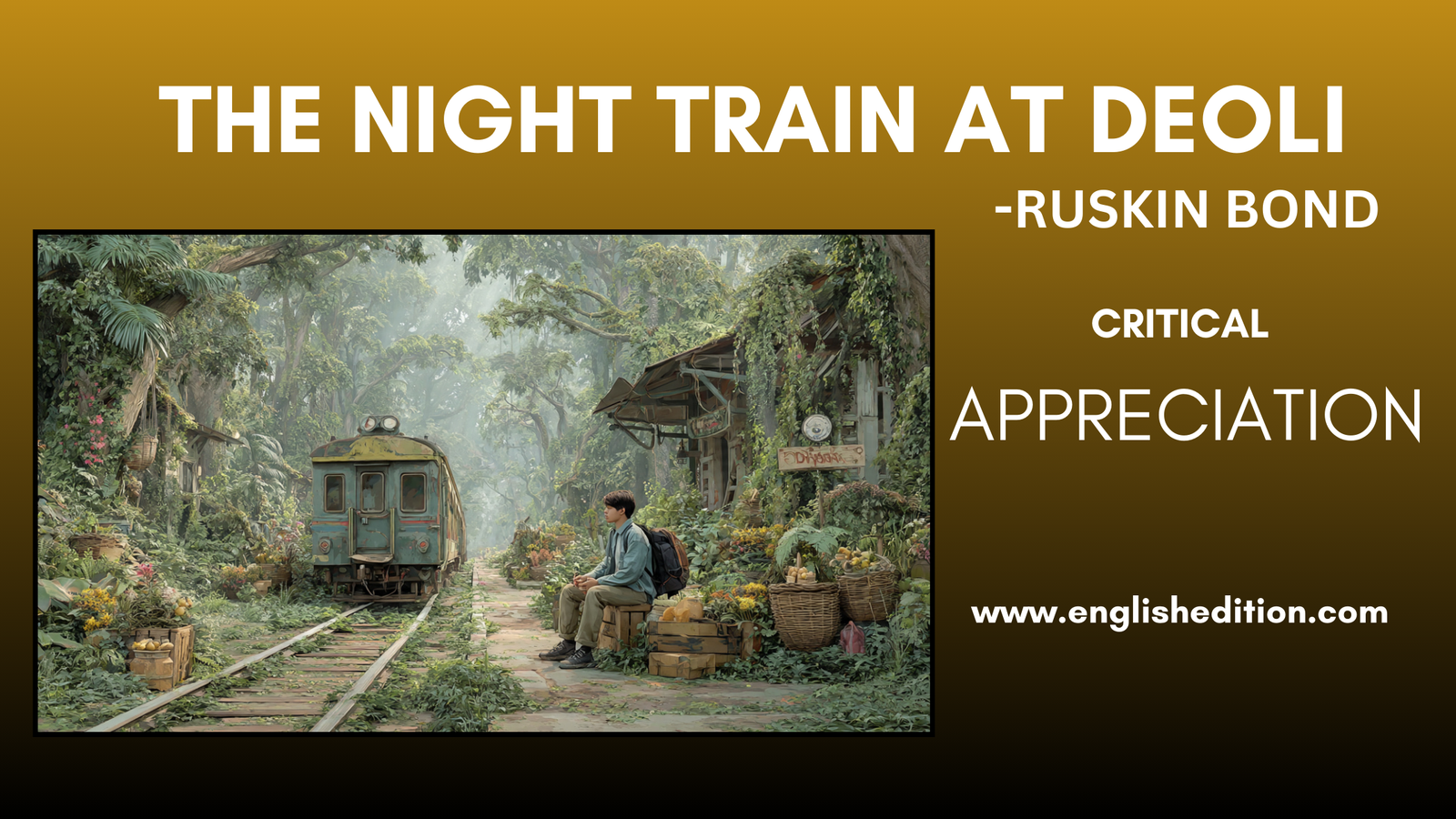
Here is a detailed critical analysis of the well noted short story “The Night Train at Deoli” composed by Ruskin Bond from his store of personal experience. We have focussd on the characters, setting, images, style and features.
The short story ‘The Night Train at Deoli’ is a romantic short story written by Ruskin Bond. It was first published in 1988 by Penguin Books in Bond’s collection of enchanting short stories named ‘The Night Train at Deoli and Other Stories’. The book has thirty short stories and this is the eleventh one. The story presents the adolescent narrator’s infatuation with a poor basket-seller whom he encounters at a
small railway station while going to Dehra.
Characters
The narrator
An eighteen-year-old college student, observant, kind-hearted and generous, gets infatuated with the basket-selling girl. He is troubled when he does not get to see her and he makes enquiries about her but in vain. The boy thinks of breaking journey at Deoli to look for her ;but realises that he is scared to find out the truth. He prefers to keep alive the hope of meeting her each time he passes Deoli.
The basket-seller
A young girl, sells cane baskets at the Deoli railway station. she is dressed in old clothes with a shawl thrown across her shoulders. She is with bare feet, pale skin, shiny, black hair and dark, troubled eyes. walking gracefully and with dignity. She feels a connection with the narrator, at the end of the story when the narrator reaches Deoli for a third time.
The tea stall owner
A small, shrivelled-up man wearing greasy clothes, usually remains busy in serving tea to the passengers. He remembers the girl who sold baskets at the station.
The old station master
This man fails to provide the narrator any information about the basket-seller girl. He gets transferred to another post.
The new station master
He is totally unaware of the girl’s existence and informs the narrator about the old station master’s transfer.
Central idea
Theme
‘The Night Train at Deoli’ written by Ruskin Bond presents the themes of brief encounters, unfulfilled desires and romance. The story is narrated by a young college student who recounts his experience
of journeying by train from Delhi to Dehra. An insignificant station called Deoli, where the train stops
for a very short time in the early morning is the central point of the narrator’s experience.
The girl
During one of his journeys, the narrator comes across a poor young girl selling baskets at Deoli station. This encounter, though brief leaves a lasting impression on him. The girl with her simple beauty
and captivating eyes attracts the narrator. He finds himself eagerly waiting for the next time he
would see her again. Thus the story captures the essence of youthful infatuation and longing for a
relationship.
Her Impression on the narrator
The narrator is fascinated by the girl not because of her physical appearance but because of a sense
of mystery that surrounded her. Despite their limited interaction, the narrator feels a growing relationship
between them which he can hardly express or define. This attachment of the narrator with an unknown girl highlights the basic human desire for relationships. The narrator’s excitement and desire to guide this
relationship to a conclusion gets disrupted when the girl stops coming to the station due to an unknown
reason.
Dreams and Relationship
However, the girl’s absence heightens the narrator’s sense of longing for her. His repeated visits to Deoli is driven by the hope of meeting the girl. It reflects the universal human nature of running after untouchable dreams and the pain of experiencing relationships.
‘The Night Train at Deoli’ handles mystery, suspense, romance and reality in an accurate way that creates a sense of nostalgia. The memories of the dream-like encounter create a world where passion becomes a priority. The ending remains enveloped in mystery like a beautiful and curious dream, the memory of which creates an elusive (difficult to catch or achieve) yet mesmerizing effect.
Critical analysis
Ruskin Bond’s ‘The Night Train at Deoli’ is a touching story of adolescent infatuation set against the backdrop of Deoli. It is a small railway station where the night train halts before entering the dense forests of the Indian Terai. The dimly lit, lonely station creates an air of mystery and solitude.
story (Critical Apprepriation of The Night Train at Deoli)
During one of his journey to Dehra, the narrator once sees a young girl selling cane baskets at the
Deoli station. Driven by an irresistible infatuation, he leaves his seat to approach her. This encounter
beautifully captures the theme of ‘love at first sight’. The brief encounters with the girl cast a spell on the
narrator and he feels a longing to meet her again and again.
simple prose
Bond’s simple yet elegant prose evokes strong emotions. When the girl eventually vanishes leaving behind unanswered questions and an aching void, it makes the readers feel the narrator’s longing and sorrow. Written in first person narrative, the story captures the universal experience of brief yet meaningful connections that leave a profound effect on our lives.
imageries
The imageries used in this story by Ruskin Bond are vivid and they easily capture the minds of the readers. The Deoli station, with its solitary platform, a tea stall, a fruit vendor, and a few stray dogs, serves
as a mere pause in the narrator’s travels. It is a place where nothing notable ever happens. Such descriptions create a sense of remoteness and isolation.
symbols (Critical Apprepriation of The Night Train at Deoli)
Besides, Bond also uses symbols to present his ideas in an effective way. The jungle beyond the station represents the mysteries of life and the unexplored emotions of the heart. The cane baskets sold by the girl symbolise the simplicity, resilience and the beauty found in humble living.
The train suggests the journey of life that is filled with fleeting encounters and missed connections.
Despite the narrator’s resolve to break his journey at Deoli one day and uncover the mystery of the girl,
his fear of shattering the illusion and facing an unpleasant reality holds him back. Thus, Deoli becomes a symbol of his unfulfilled desires, a place where he can imagine a different ending each time he passes through.
economy
Despite being an emotional story, it hints at the stark economic inequality in the society. The girl’s poverty contrasts with the privileged background of the narrator, emphasizing a societal gap between them.
The narrator misses the girl yet he chooses to remain enclosed in his world of romance. In conclusion, ‘The Night Train at Deoli’ is a beautiful short story through the eyes of a teenager. He captures the obsession with a passion often seen
during adolescence.
style
The prose is simple, written in easy language. This explores the themes of youthful longing, curiosity, and the bittersweet nature of unfulfilled desires. The plot is straight with realistic description of events. This is evident when the narrator says that a film or fiction would have given his story a fitting conclusion. The presentation of a mystical environment, the brilliant use of brief conversation and the intricate detailing of adolescent psyche (the human mind) – all create a long-lasting impression on the mind of the reader.