 By englishedition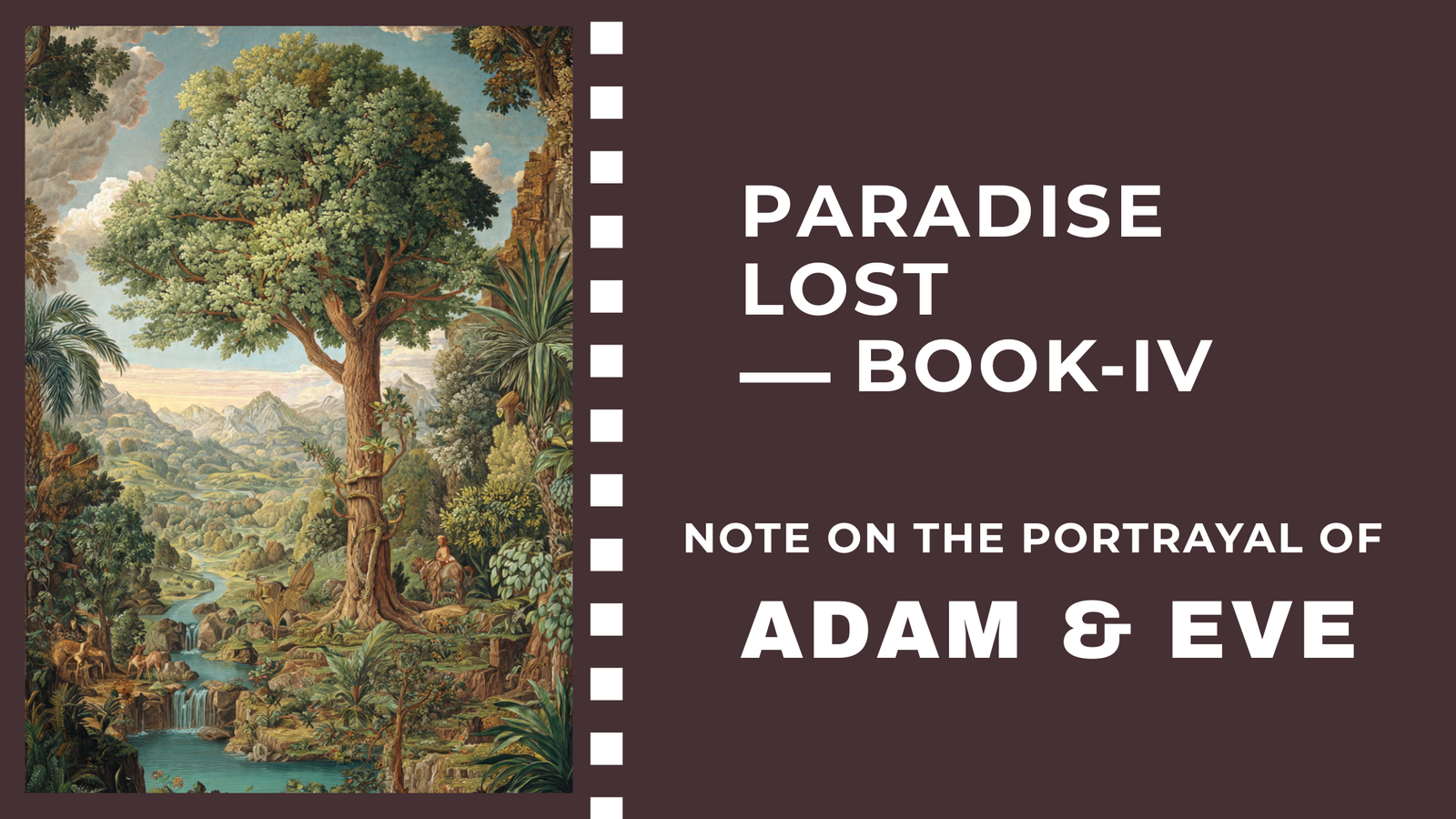
In this article, read the portrayal of Adam and Eve in Paradise Lost Book IV. Detailed analysis of their character, innocence, love, and Milton’s vision. PORTRAYAL OF ADAM AND EVE IN PARADISE LOST. BOOK-IV is very important in the assessment of the Poetry.
PORTRAYAL OF ADAM AND EVE IN PARADISE LOST. BOOK-IV
Introduction
“The plan of Paradise Lost”, according to Dr. Samuel Johnson, “has this human actions, nor human manners.” In the deline ation of the characters of Adam and Eve, the First Man and Woman, Milton did not endow them with any experience that might characterize any human being. We, the ordinary mortals, have experience, but the First Parents are devoid of any. Adam and Eve are not merely beautiful, they become central to the whole scheme of the epical the me without losing the celestial grace.
Adam and Eve as Symbols of Innocence
In their primal innocence, their frank and innocuous love and in their subtle, yet unmistakable difference, Adam and Eve cast a sort of radiant bravura to the whole epic. Particularly in the Fourth book where they have been introduced, they fit in admirably with the inconvenience that it comprises neither general beauty of Eden.
The Garden of Eden, the abode of Adam and Eve in their prelapsarian stage, in Milton’s Paradise Lost Book-IV, embodies an ineffable natural beauty, thereby reminding us of the idyllic order of existence. It is an elevated, enclosed garden or park occupying the level top of steep, rugged circular hills whose sides are covered by a brake or wilderness. Abounding in sweet scented flowers and fruits, melodies of birds, soft music produced by the falling of water in the fountains, the beauty and serenity of Eden can
frequented by Proserpine during her earthly visits, the natural hero in Milton’s Paradise Lost, incarnates absolute innocence, purity and beauty.
The Garden Of Eden and Adam
Actually, he is the Aeneas, devoid of human experience: “Adam the goodliest man of men since born / His sons.” He is, indeed, the lord of creation which exists entirely for him and for Eve. The dwelling of Adam is rich with all the beauty that flowers and trees can He is not, as C.M. Bowra notes, ‘a natural man and Rousse au was later to imagine himi still less he is the primitive savage of anthropology.’
Milton has shown Adam to have two unquestioned loyalties to God and to Eve. For God Adam feels, above all, gratitude for having set him in such bliss. He gladly gives praise and keeps in mind the single prohibition that he must not eat the fruit of the Tree of Knowledge. It is a part of his daily task to offer
wors hip to God during the period of morning hymn. Adam’s other devotion is to Eve, the Mother of Mankind. Eve, who represents paramount female beauty. is the only human being that Adam knows. To her he gives all his human affection and he loves her with a complete unquestioning love.
Adam and Eve
Adam and Eve, therefore, together form a rapport of ideal marriage. Milton very béautifully represents Adam and Eve in their sleep in the leafy bowers, lulled by the music of nightingales:”. happiest if ye seek / No happier state and know to know no more. .Sleep on / Blest Pairi and O yet Milton has invested Eve with all the charm and grace of beautiful womanhood. Her sweet reluctant amorous delays and her coy submission make her exquisitely feminine in character-traits. There is grace in all her steps, heaven in her eyes and dignity and love in every gesture. She is made for softness and sweet attractive grace as Adam is made for contemplation and valour.
Eve, a woman
Eve recognizes no God except Adam and is content him meekly. Her sweet womanly natures make her again and gain picture the thrill and rapture of her bridal night. She remembers how she woke up on
a bank of sweet smelling flowers of various colours, how she was charmed by the reflection of her won loveliness in the clear waters of the lake, and how she came upon Adam and fled from him being frightened. Where as Adam pays half of his attention to the worship of God, Eve concentrates the entire
of her attention on the worship of Adam.
Adam’s Character Analysis
Without Adam nothing in Paradise would have the power to please her. She is not without that womanly
curiosity which marks her out immediately as the eternal feminine.’ This curiosity is innocence as yet, but we realize already that this curiosity which marks her innocence which now, relates to the movement of stars and the planets may take a serious and dangerous turn afterwards. Incidentally, it is through this feminine vulnerability that Satan entered in heaven and to worship motivated Eve to test the fruit of the forbidden tree.
conclusion
The romantic charm and beauty of Adam and Eve in Milton’s Paradise Lost Book IV, is nonpareil. Understandably, even the devil, Satan who reaches heaven a snake in cognito, relents at the sight of so much grace and innocence both in Eden and in Adam and Eve. He, however, is disarmed for the momnent by their beauty and conjugal felicity. Of course, it is Adam’s sensuous attraction for Eve that courts disaster in their fate in particular and that of mankind in general.